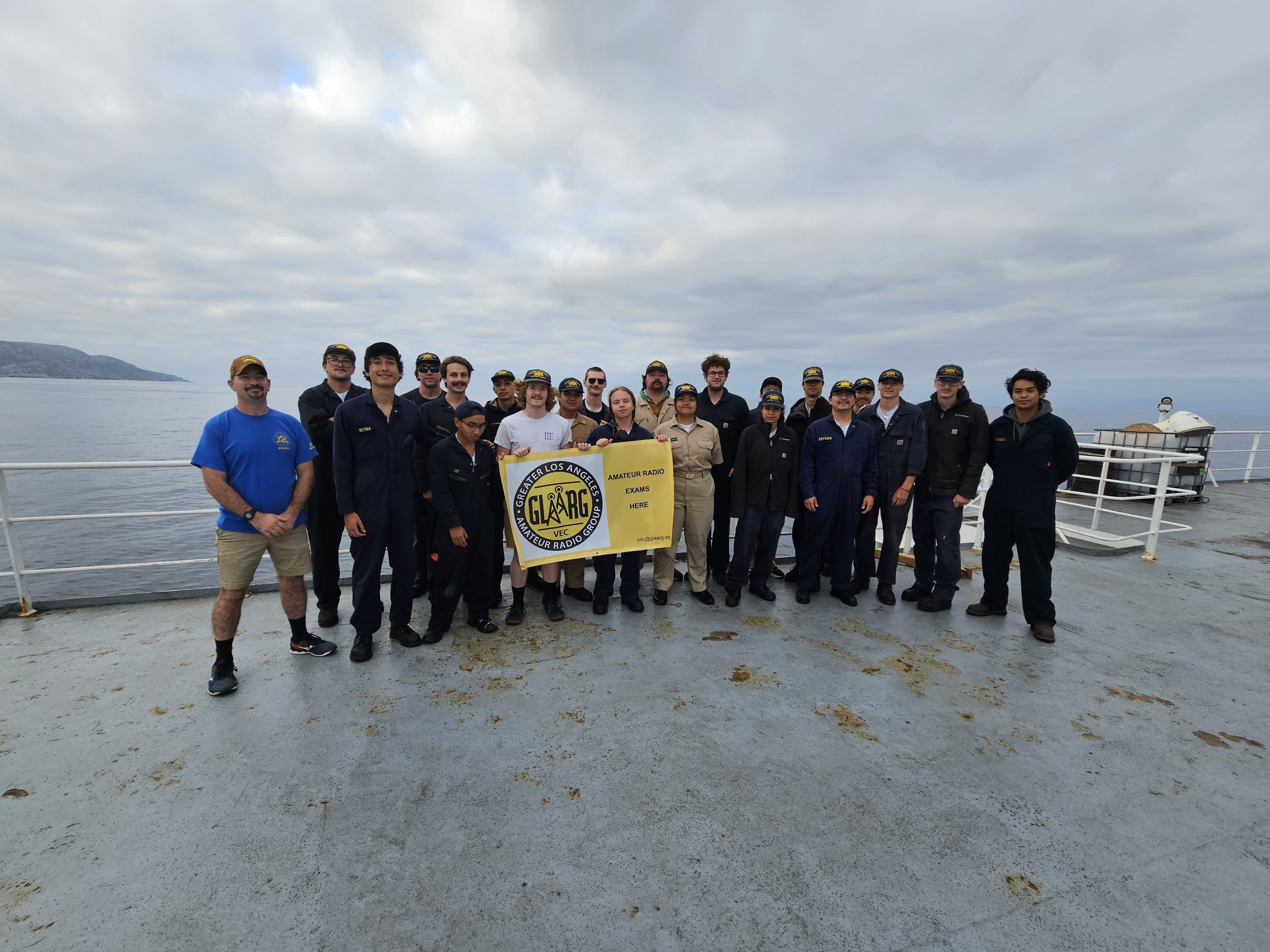
On June 29th, 2026, CPARC worked with Cal Poly Maritime Academy to run our second annual Ham Exam at Sea on June 29th while cadets were in transit across the Pacific Ocean. The following is a blog post written by David Satterwhite, an associate professor at Cal Poly Maritime Academy, about the event.
For the second consecutive year, Cal Poly Maritime Academy successfully conducted FCC Amateur Radio examination sessions while underway aboard the Training Ship Golden Bear, continuing a program that remains one of the most unique amateur radio testing initiatives anywhere in the world.
During the 2026 Summer Sea Term, cadets achieved outstanding results. A total of 34 participants earned their FCC Technician (Element 2) licenses, 13 of those operators continued on to successfully earn their General Class (Element 3) licenses, and one exceptional cadet accomplished the rare feat of earning all three FCC amateur radio licenses during the voyage, passing the Technician, General, and Amateur Extra (Element 4) examinations after beginning the trip with no amateur radio license at all.
These accomplishments reflect the dedication, technical knowledge, and perseverance of our cadets. Advancing from Technician to General during the same testing session is an impressive achievement. Completing all three license classes during one Sea Term is truly extraordinary and demonstrates an exceptional commitment to learning.
The examinations were administered remotely through Zoom by an outstanding team of Volunteer Examiners from the Greater Los Angeles Amateur Radio Group (GLAARG) and the Cal Poly Amateur Radio Club (CPARC). Their professionalism, flexibility, and willingness to conduct FCC examinations while the Golden Bear was hundreds of miles from shore made these unique testing sessions possible. On board the ship, Engineering Professor David Satterwhite, Luke Garner, and Cadet Lucas Cheung assisted with local proctoring and/or coordination, ensuring the examinations were conducted smoothly and in accordance with FCC and Volunteer Examiner Coordinator procedures.
A very special 73 goes to GLAARG for its extraordinary generosity and support of this program. In addition to providing Volunteer Examiner support, GLAARG graciously covered all examination-related expenses, including every FCC application fee for our cadets, ensuring that cost was never a barrier to participation. Their investment in the next generation of amateur radio operators and maritime professionals has been instrumental in the continued success of this program.
We also extend our sincere appreciation to the Cal Poly Amateur Radio Club (CPARC) for donating their time and expertise to assist with the administration of the FCC examinations. Their Volunteer Examiners played a vital role in making these at-sea testing sessions a success, and their continued partnership is greatly appreciated.
Amateur radio continues to provide tremendous educational value for maritime students. It reinforces principles of electronics, radio frequency communications, emergency preparedness, problem solving, and self-reliance, while giving cadets the opportunity to communicate with operators around the world. These are skills that complement maritime education and prepare future officers for both routine operations and emergency situations.
What began as a historic first has now become an exciting annual tradition aboard the Golden Bear. Each newly licensed operator joins a worldwide community of amateur radio operators while helping strengthen Cal Poly Maritime Academy’s reputation for innovation, hands-on education, and technical excellence.
Congratulations to every cadet who accepted the challenge, studied hard, and earned a new FCC amateur radio license this summer. Your accomplishments are something to be proud of, and we look forward to hearing many of you on the air in the years ahead.
Thank you to the Volunteer Examiner teams from GLAARG and CPARC, to everyone who supported the testing effort ashore and aboard the Golden Bear, and especially to GLAARG for its generous financial support. 73, fair winds, clear frequencies, and Bravo Zulu to all who made another successful year of at-sea amateur radio testing possible.